
Remember back in the old days, when social media was that friendly, happy online space that filled your downtime with whimsical photos of cute cats and dogs, and your friends sharing memories with laughter and song? You know, just looking for connection. No? Me neither! What the hell happened!?
I joined Facebook back when it was still mostly baby photos and blurry vacation sunsets.
Back when the biggest controversy in my feed was whether someone had over-cooked their lasagna.
I signed up for one simple reason: I wanted to see what my friends and family members were up to. That was it. No lofty digital philosophy. No grand influencer ambitions. Just a mildly curious dad who didn’t want to miss out on the latest dance photo or someone’s epic road trip details.
And for a while, it worked.
But somewhere along the way, something shifted.
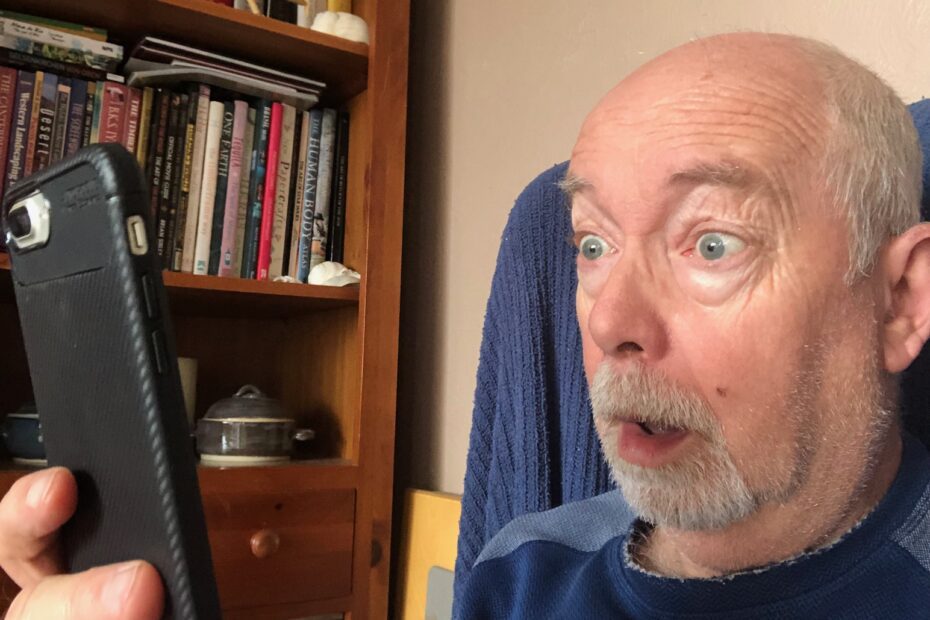
These days I log in intending to check on a couple of friends… and within five minutes I’ve been informed that civilization is collapsing, democracy is hanging by a thread, and apparently I should be outraged about at least three things before my second coffee. And I usually am!
It’s impressive, really.
I went looking for connection and came away with elevated blood pressure.
Cable News or Online Community
Now, I’m not naïve. Facebook isn’t a charity. It’s a business. Businesses need revenue. I understand that. I’ve built enough things online to know that “free” usually means someone, somewhere, is paying in a different currency.
But I can’t shake the feeling that the mission quietly drifted. What started as a digital town square feels more like an American 24-hour cable news channel where the volume knob is permanently stuck on high.
And if I’m feeling that at my age, with a (reasonably) stable identity and a fully formed prefrontal cortex, I can’t help but wonder what it’s doing to people who are still figuring out who they are.
Which is how I found myself poking around two newer platforms. One called Eh. One called hey.cafe.
Not because I’m staging a dramatic exit. Not because I suddenly think I’ve solved social media.
Just because I’m curious whether smaller, slower, more human spaces still exist online.
It’s Not Designed to Make You Angry
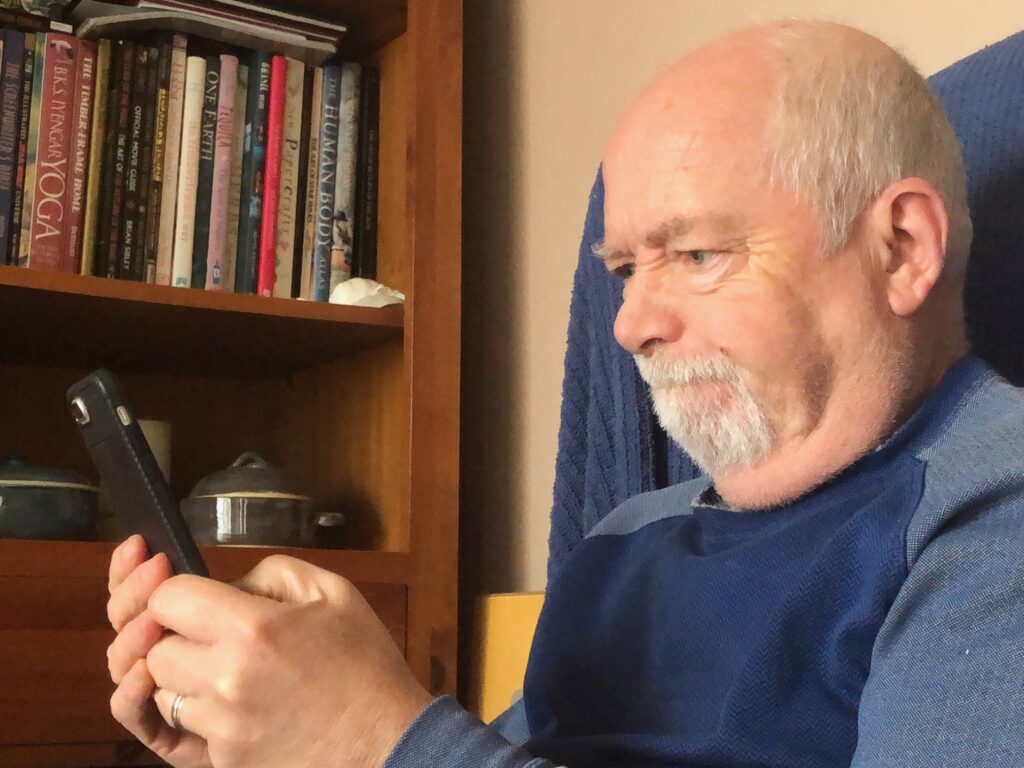
Now I’m pretty sure Facebook didn’t wake up one day and decide to make us miserable. It optimized for something reasonable. Engagement. Time on platform. Clicks.
The problem is what “engagement” actually means in practice.
But it turns out, we don’t linger on heartwarming content. We linger on things that make us feel something urgent. Outrage. Fear. The sense that someone, somewhere, is deeply wrong and needs to be corrected immediately, preferably in the comments. A vast breeding ground for keyboard warriors.
The algorithm figured that out early. And it leaned in.
So the feed quietly shifted. Not all at once. Gradually. Like the temperature of water around a frog.
Your cousin’s vacation photos got pushed down. And a post about why your political views are personally destroying the country got surfaced. Not because anyone decided you needed that. Because it kept you scrolling. And scrolling is the whole business model.
The result? Moderate voices get drowned out. Nuance doesn’t travel well. But somehow, everyone online seems to have stronger opinions than anyone you’d actually meet for coffee.
It’s not evil masterminds pulling levers. It’s a system optimized for profit that happens to run on outrage. That distinction matters, but it doesn’t make the outrage feel any less exhausting.
What’s It Doing to Our Kids?
I think about this a lot. Because I’m a dad. And my kids are on social media. Zach just a little. Beth-Rose more.
Back in my innocent, naïve, early days of being a “responsible” parent, the concern was “screen time”. How much time were they spending on the iPad, or in front of the big electronic babysitter? My goodness, how things change!
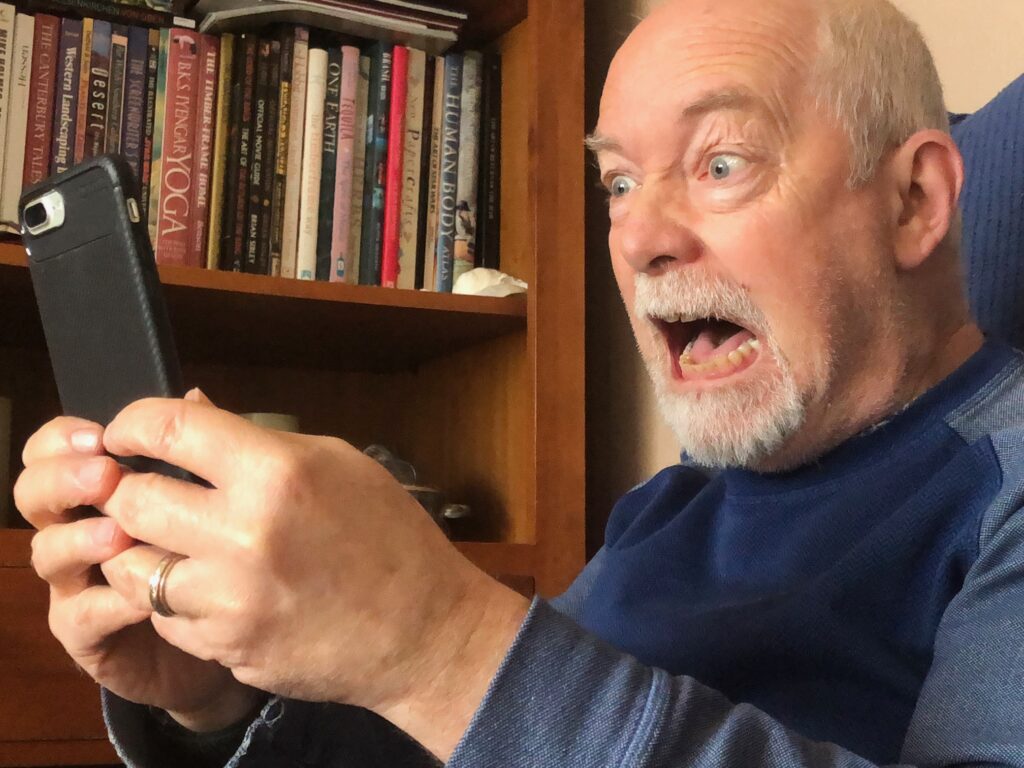
If the algorithm rewards outrage and punishes nuance, what does that do to someone who’s still figuring out who they are? What does it mean to form your identity inside a system that’s been quietly optimized to make you feel like every issue requires you to pick a side, get angry, and defend your tribe?
It’s not that young people are more extreme. No, it’s that extreme content gets amplified, and they’ve grown up in an environment where that’s just how online spaces work. The outrage is the background noise. The pile-on is the normal response to disagreement.
If this is the water our kids are swimming in while they figure out who they are, what does that do to nuance? To patience? To the ability to sit with a complicated question without needing to immediately declare a winner? It’s certainly not helping kids who are just looking for connection.
I’m not pointing fingers at a generation. I’m questioning the system they inherited. There’s a significant difference.
I Started a Little Experiment
So there I was, equal parts fed up and curious, when I stumbled onto two platforms that both seemed to be asking the same question I was: what if social media was actually designed around people instead of profit?
Meet Eh (ehnow.ca) and hey.cafe.
Both are smaller. Both are quieter. And both made me feel like I’d walked out of a packed, noisy arena and into an actual conversation.
Eh: Canadian, Community-First, and Yes, There Are Cat Photos
When I first landed on Eh, my instinct was skepticism. Another social network? Sure. Right between the kombucha and the mindfulness app, I assume.
But a few things caught my attention.
It’s Canadian. Built right here at home, on Vancouver Island, by a founder who spent years at places like Reddit and Lululemon and apparently got tired of waiting for someone else to build something better. The data lives on Canadian soil. And the mission is local connection, not global engagement metrics.
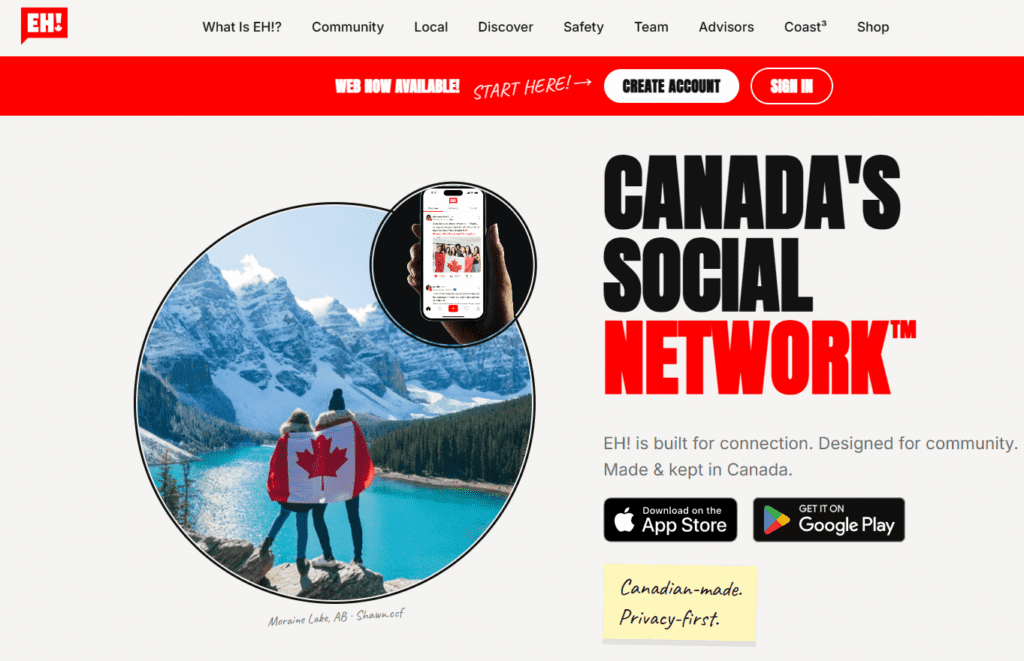
No manipulative algorithms. No comment-section toxicity engineered for clicks. The goal is meaningful interactions, not maximizing screen time. They’re even building tools designed to move people from their screens to actual in-person connection.
I know. Wild concept.
And here’s something that impressed me: it was easy to find my people right away. They’ve built out a solid selection of groups you can join from the start, which means you’re not just staring at an empty feed wondering what you’ve done with your life.
Within about ten minutes I’d joined an Authors group (because yes, I am) and a group dedicated entirely to posting cat pictures. There’s a group for my local area, and groups for just about anyone with a particular hobby, interest, or profession.
Now I want to be clear: I did not actually intend to join a cat picture group. And yet here we are. Apparently that’s who I am now, and I’ve made peace with it.
hey.cafe: No Ads, No Algorithms, No Nonsense
hey.cafe takes a slightly different approach, but arrives at a similar destination.

It’s built around “cafes” rather than groups, which sounds like a small distinction until you’re actually in one and it genuinely feels more like a conversation than a broadcast. There are no ads. No personal data collected or sold. No algorithm quietly deciding what you’re allowed to see. Hate, harassment, and abuse are strictly off the menu.
Just people, talking.
And I’ve found my way into a Writers and Bloggers Hub, a hiking cafe (because, despite my sedentary lifestyle, I have an outdoorsy side that occasionally shows up), and yes, before you ask, a cats cafe. The cats, it seems, are non-negotiable wherever I go.
I also stumbled into a community run by Tod Maffin, which for any Canadians in the room, is a pretty solid signal that interesting people are already finding their way here.
Is it perfect? I’m still exploring. But it feels like a space where someone actually thought about what kind of community they wanted to build before they started optimizing it for growth.
Where Does That Leave Us?
I’m not staging a dramatic exit from Facebook. I don’t think two platforms are going to fix what’s broken about our digital culture.
But I do think the spaces we spend time in shape us, quietly, over time. And maybe it’s worth asking what kind of spaces we actually want. Especially if you’re, like me, looking for connection.
So, do we want scale or connection? Volume or conversation? Platforms optimized for our attention, or ones designed for our community?
I don’t have a clean answer. After all, I’m just a guy who went looking for his friends’ vacation photos and ended up here, asking questions. Just looking for connection.
Maybe that’s enough to start.
But if you want to check them out: Eh is at ehnow.ca and hey.cafe is at hey.cafe. Both are free to join, both are Canadian, and apparently both have very welcoming cat communities waiting for you.
Not that I’d know anything about that. But look me up there, just in case. And if you do, my hey.cafe link is https://hey.cafe/r/frazzledad
What do you think- are you feeling the same fatigue with the big platforms? Or have you found ways to make them work for you? I’d love to hear it in the comments.

For some reason my Facebook feed is a bunch of AI generated soft porn reels. I’m not sure why.
Huh, weird!