

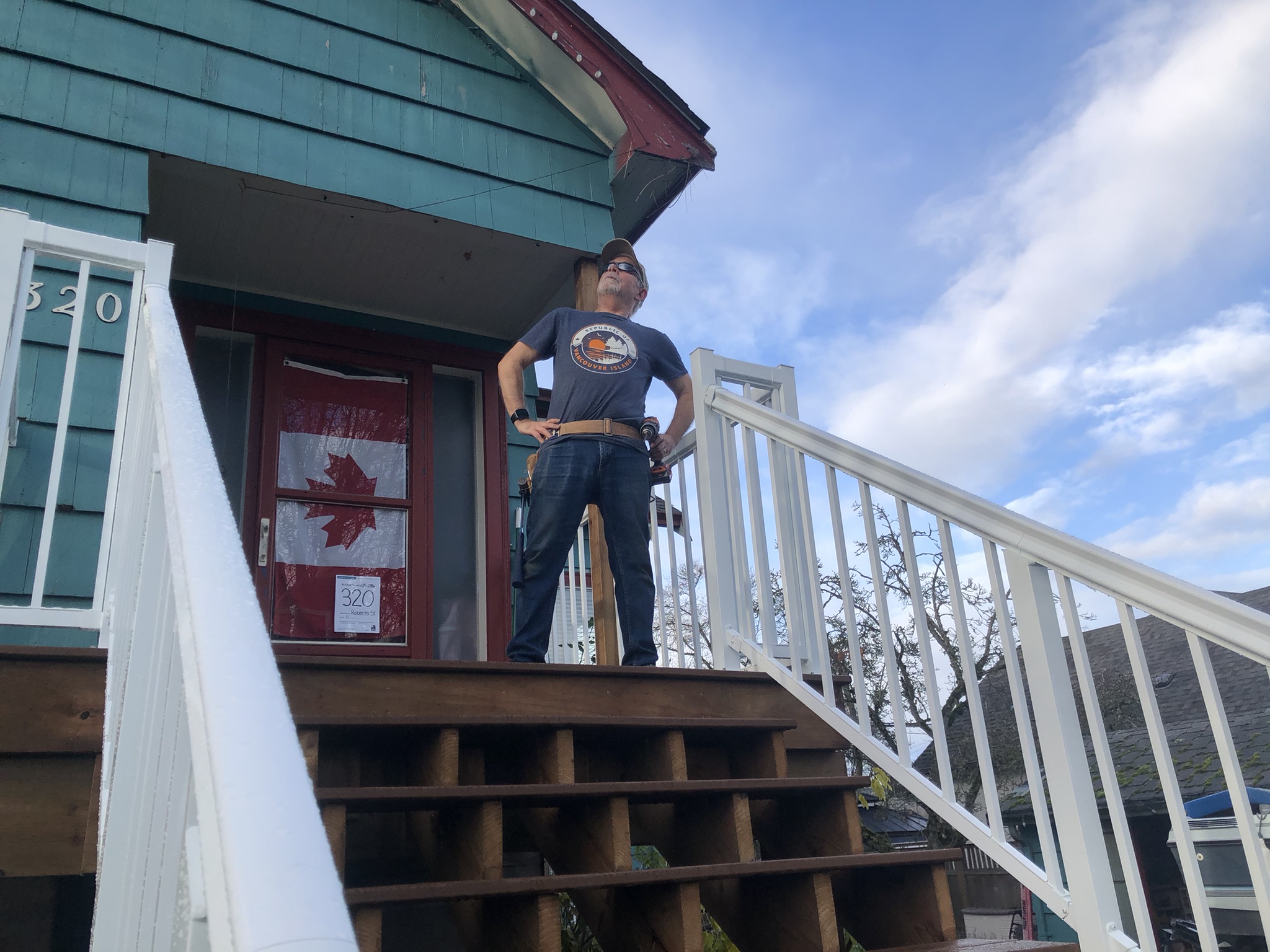
I was given an unexpected gift this year: a simple little project. Just a little DIY porch building.
Our old, crappy concrete front porch needed replacing. It was broken, cracked and separating from the house. It needed to go.
“Just rebuild the front porch,” I told myself. “How hard can it be?”
Crap.
But I started with such good intentions. I started smart. I hired someone else to demolish the old porch. Now way was I spending the day on a jackhammer, then figuring out where to bury all that old concrete.

But once they had finished dealing with 11 metric tonnes of concrete over 3 days, and I was left with a giant hole in front of my house, it was my time. Time to go all Bob Vila.
In my mind, this was going to be one of those satisfying homeowner montages you see in hardware store commercials. I’d sip coffee, nod confidently at a set of plans, measure once (maybe twice, if I was feeling insecure), and by weekend’s end my DIY porch building project would be done. I’d feel pretty chuffed, hands on hips, like a slightly older, slightly creakier Bob Vila.
Instead, I met the Town.
Step One: Ask a Simple Question, Open the Gates of Hell
It all started with a rookie mistake.
I went to the Town office and asked, “Howdy, do I need a permit for my DIY porch building job?”
Had I kept my mouth shut, the porch would be finished months ago, and I’d be sitting on it with a beer and a smug sense of accomplishment. Instead, by asking that one innocent question, I effectively hit the “Start New Quest” button in some municipal video game I didn’t know I was playing.
Suddenly I needed:
- A permit application
- A site plan
- Setback measurements
- Footing specs
- A structural drawing that looked suspiciously like it wanted calculus
The building department very helpfully informed me that before I poured anything, before I framed anything, before I even dreamed about setting out a 2×10, they needed to inspect my forms.
No problem, I thought. I’ll just build my forms, call for an inspection, get the thumbs up, and be on my way to DIY Porch Building Glory.
So naturally, I went ahead and… poured the concrete.
Because in my mind, a “forms inspection” is something you do when the forms are full of concrete, right? You know, all form-y. Solid. Impressive.
Apparently not.
The inspector came by, looked at my already-poured footings and piers, and gave me the expression you reserve for toddlers who have just proudly finger-painted the wall with peanut butter.
“No,” she said. Just… no.
My footings weren’t thick enough. They wanted more concrete under the piers. The forms should have been inspected before I poured. Now I was flirting with the possibility of ripping it all out and starting over.
Crap!
Step Two: Redesign Your Life (and Porch) to Avoid Re-Pouring
Now, I’m all for doing things right. But there’s “doing things right” and then there’s “renting a jackhammer, excavating my entire front yard, and re-enacting a scene from the movie Holes.”
I chose option C: Get creative.
I started calculating, sketching, and muttering to myself in the yard like an older, friendlier (maybe less grumpy?) version of the guy who shouts at pigeons in the park. Could I adjust the framing? Shift the beams? Change the stair layout? Offer the inspector cookies?
Eventually I found a way to redesign the porch, reducing the number of piers and still work within code. I drilled holes in the pier bases and measured the depth. Then I took pictures of the measurements and emailed them to the inspector. My measurements showed I was at least in the ballpark for depth. No jackhammers required, and the inspector didn’t even sigh too loudly when I showed her my revised plan.
Victory! I thought.
Then I discovered the pier without peer. And a near DIY porch building disaster.
Step Three: The One-Inch Problem That Nearly Broke Me
Somewhere in the measuring, re-measuring, and “I’m sure that’s close enough” stage of the project, one of my concrete piers had decided to be special.
It was one inch off.
Not an inch out of level. No, that would have been too easy. This pier was one inch shorter in length along the line of the future stairs. In other words, when I went to lay out where my beautiful, straight, square beam would land, one concrete pier was just… shy.
One inch. Two point five four measly centimetres.
I stared at it for a long time, hoping it would grow.
It didn’t.
Now I had two choices:
- Break it out and re-pour it.
- Figure out a way to make the stairs square to something that was not, in fact, square.
I chose option 2, also known as “creative carpentry” or, more honestly, “fudging it until physics stops complaining.”
The solution? Furring strips.
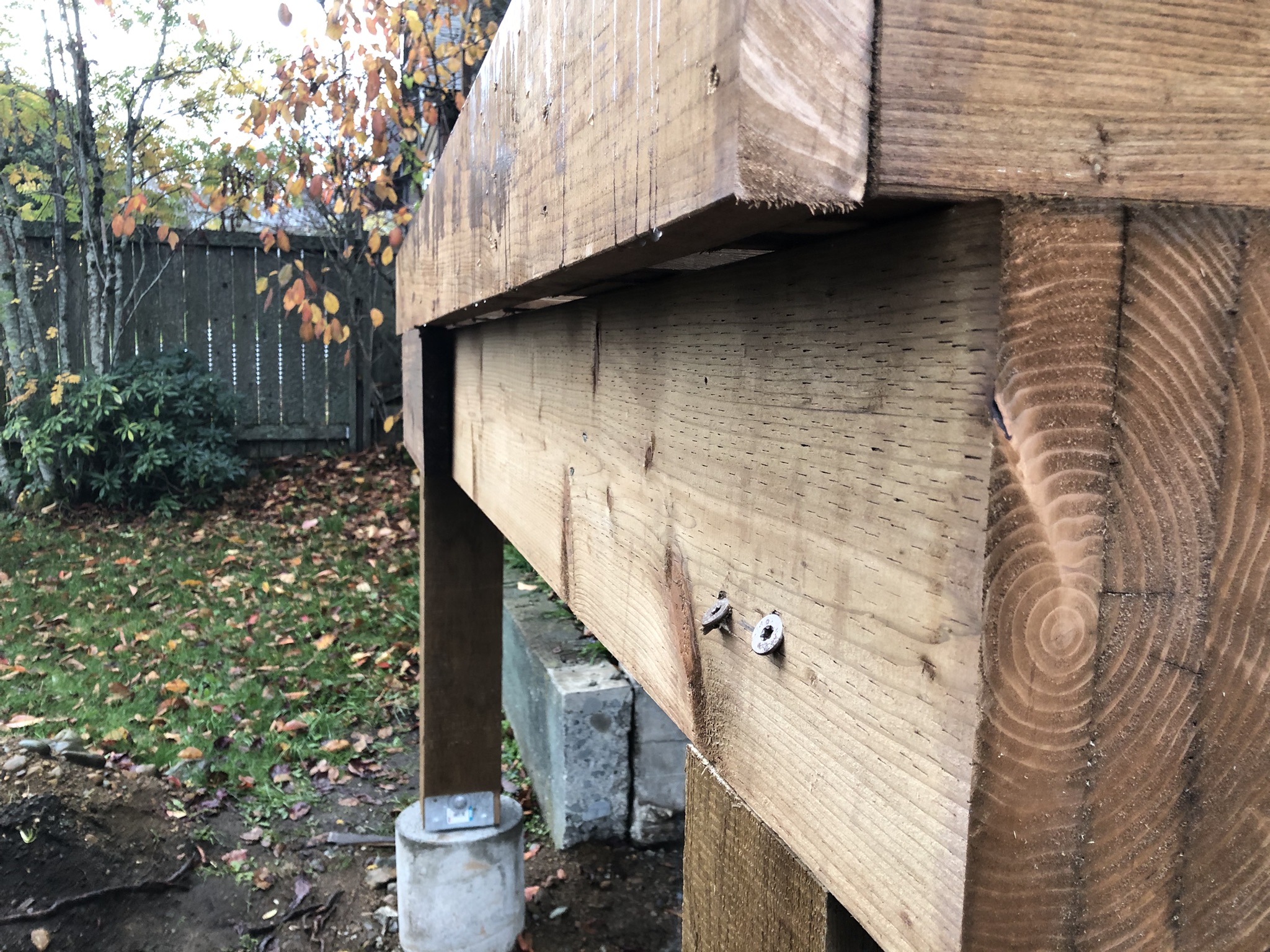
I started adding furring strips along the side that was too short; thin at one end, thicker at the other, building up the missing inch in careful little increments. Like orthopedic insoles, but for wood. By the time I was done shimming and furring and re-measuring, the beam for my stair stringers was finally square enough that Pythagoras could unclench.
It worked. The stringer layout lined up. The tape measure agreed. I didn’t have to change a thing. DIY porch building disaster averted.
I may have whispered, “Take that,” at the pier. It knows what it did.
Step Four: Eight Risers, No Batteries
With the concrete drama behind me, it was finally time for one of the classic rites of passage in DIY lore: cutting stair stringers.
This is where you lay out all the rises and runs on a long 2×12, double-check your math twelve times, stare at it for another ten minutes, and then, heart pounding, make the first cut.
I had my layout. I had my saw horses. And my circular saw. I had my cordless jigsaw for those little bits at the corners of my cuts.
What I did not have was batteries.
Somewhere between “I’ll put these on the charger so I don’t forget” and “Where did I put those?” my jigsaw batteries had vanished from the known universe.
CRAP.
But I had momentum. I had caffeine in my system. I was not about to drive to the store or wait around. No, no. That would be sensible. Instead, I looked at my circular saw, looked at my handsaw, and thought, “How hard can this be?”
Each stringer needed eight riser cuts and eight tread cuts. I had six stringers to do. So I rolled up my sleeves, channeled my inner 19th-century carpenter, and started cutting by hand.
By the time I finished the first stringer, my left arm had questions. By the second, it had complaints. And by the third, it had filed a formal grievance.
On the final stringer, sweat dripping, shoulder burning, I reached for my tape measure and glanced over at the sawhorse.
There, glowing like a holy relic, were my jigsaw batteries.
Fully charged. Sitting politely. Watching the whole time.
Step Five: Somehow, It Starts to Look Like a Porch
I quietly set them on the bench, picked up my hand saw again, and finished that last stringer out of pure stubborn principle. My arm may never forgive me, but my pride insisted.
Eventually, despite the Town, the footings, the one-inch pier, the furring-strip acrobatics, and the medieval stringer workout, things started coming together.
Posts went in. Beams got bolted. Joists lined up. Stairs actually landed where they were supposed to. From certain angles, the whole thing even looked… intentional.
The inspector came by again. She walked around, peered at my handiwork, took notes on her clipboard, and didn’t once use the word “non-compliant.” In inspector language, that’s basically a hug.
By the end of the day, I stood out front, looking at the skeleton of my new porch. The concrete was solid. The framing was square (trust me, it is, I checked). The stairs were cut. And my left arm was hanging at my side like it belonged to someone else.
I could now proceed with installing my composite deck boards and stair treads. Can I get a Halleluja!

Naturally nothing ever goes according to plan, especially when you think you’re past the bumps.
A framing approval is not the end. It’s just the point where the inspector smiles and says, “Looks good,” and you hear, “Congratulations, you’ve unlocked Level Two: Finish Work.”
Now I had to actually finish the thing: deck boards, stair treads, railings. You know, the visible parts people will judge me on forever.
I started with the stair treads, because they felt like a nice, contained little task to ease into the finish stage.
Lies. All lies.
Screwed
The treads themselves went on reasonably well, once I figured out spacing and overhang. The real joy began with the screws. I quickly discovered that if I didn’t drill countersink holes for each screw, the tiny screw heads wouldn’t disappear into the composite. They’d just sit there, mocking me, proud little tan coloured mushrooms on every step.
No problem, I thought. I’ll just use proper composite screws.
Except I didn’t have proper composite screws.
The only ones available locally were “special order,” with a shipping time that sounded suspiciously like “whenever we get around to it.” I wasn’t waiting another week (or more) to keep working on something that has already consumed a large chunk of my fall, and my will to live.
So I soldiered on with the screws I had. These screws and the composite did not get along. Every time I drove one in, it would choke on the composite shavings, bind up, and refuse to go any deeper. So for each screw, I would:
- Drill the countersink.
- Drive the screw.
- Swear.
- Back the screw out.
- Clean the threads.
- Drive it back in.
- Repeat step 3 as needed.
Multiply that by a whole staircase and suddenly this “fun little project” felt like a repetitive strain injury with a materials budget. My knees revolted. Every time I had to stand up, they screamed obscenities at me.
Once the stairs were finally done, or at least done enough that I could walk up them (painfully) without seeing my life flash before my eyes, it was time for the deck surface. I decided to get fancy and picture frame the deck boards. That means putting a nice mitred border all around the outside, with the field boards running inside it. Classy. Elegant. The woodworking equivalent of wearing a spiffy blazer.
Getting Fancy With A Picture Frame
The good news: my deck framing was actually square. Miracles do happen! Which meant that if I cut all my mitres at 45 degrees, the corners should fit together like they’d been planned that way.
And they did.
Three out of four corners came together beautifully. The mitres closed up tight. The boards sat perfectly. I was starting to feel unreasonably proud of myself. Maybe, I thought, I’m getting the hang of this.
Then I cut the last perimeter board. The longest one. The hero board that would tie everything together and complete the graceful rectangle of my picture frame.
I measured carefully. Double-checked my length. Marked my mitres.
And then I cut both ends in the same direction.
I stood there for a moment, holding this majestic, useless parallelogram of composite decking, and just let the stupidity wash over me.
CRAP!!
There was no saving it. No clever flip, no sneaky trim, no “good enough, no one will notice.” The board was simply wrong. So I added “order another deck board” to my growing list of “things future me will pay for,” and grabbed a regular straight board to slap in its place for now.
Was I going to let one bad mitre stop the project? Absolutely not. I installed the temporary board, stepped back, and told myself only three people would ever notice:
- Me
- Anyone who walks up the stairs
- Anyone who reads this post
And so the replacement board is ordered. With the temporary “not-a-mitre” board in place, I figured I could move on to the railings.
Nope.
Hurry Up and… Wait
With the replacement board ordered, I thought, Great, I’ll get a head start on the railings while I wait. Except I couldn’t, because the picture-frame board I’d screwed up was exactly where my railing posts needed to go.
Of course it was.
I needed that proper board installed before I could locate and bolt down the posts. So the project went into that special phase all DIY jobs eventually hit: staring at things and waiting for a delivery.
A few days later, the precious new board arrived. This time I measured it like I was defusing a bomb. Triple-checked the mitres, dry-fit it, adjusted it, and only then committed to the cut.
It slid into place like it had always belonged there.
Why couldn’t I have done that the first time? We’ll never know.
Blocking for the posts was already in, so now I could finally start on the railings. I was basically in the home stretch.
So naturally, that’s when the next problem showed up.
The Great Stair Splice Mystery
Everything went pretty smoothly on the flat sections. Posts in, top and bottom rails on, pickets placed and spaced, everything squared up, my spirit level giving me the occasional nod of approval. Then I got to the stair handrails.
The span was too long for a single rail, so I had to splice two together. No problem. The system came with special splices just for this purpose. The instructions said, very clearly:
Screw the bottom part of the splice into the bottom of the handrail.
Okay, great. That’s one part. But the splice is in two parts: a bottom piece and a top piece that nest together.
The instructions were completely silent on that second part. I found nothing about how to actually attach it to anything. Nothing about screw length. Nothing about orientation. Just a vague sense of “trust us, it’ll be fine.”
Here’s the other fun bit: the supplied screws were not long enough to go through:
- The bottom of the handrail
- The bottom half of the splice
- The top half of the splice
They would enthusiastically commit to maybe two of those. Three was asking too much.
So now I had a stair rail to splice, hardware that didn’t reach, and instructions that might as well have said, “Good luck, chump.”
Ask Professor Google
I did what any modern DIYer does at this point: I went to ask the internet.
Specifically, I spent a solid hour arguing with Google’s AI helper, which insisted on giving me answers to questions I hadn’t asked, for products I didn’t own, from brands I’d never heard of. Eventually, after a lot of rephrasing and back-and-forth, it concluded that the most likely explanation was that my splices were defective and I should get new ones.
Sure. Let me just tell my deck hardware that it has failed me emotionally and physically and must be replaced.
Instead, I grabbed the offending handrail section, the splice, and the screws, and marched back to my supplier. I put everything on the counter and said, “Okay, explain this.”
He studied the parts, flipped things over, measured the screws, re-read the same instructions I’d already memorized, and finally admitted he was stumped too.
We eventually came to the deeply technical solution of:
“What if we just use a longer self-tapping screw and go through everything?”
Brilliant. Approved. Done.
Armed with my new, actually-long-enough screws, I went back home and installed the splice exactly the way the instructions should have described it in the first place. The rail came together beautifully, and my faith in basic mechanics was restored.
For about five minutes.
The Picket That Would Not Die
With the posts up, rails in, and splices conquered, it was finally time for the last big job: installing the stair pickets.
This part, I was assured, was easy. The system uses snap-in spacers and pickets: you snap a spacer into the bottom rail, drop a picket in, snap another spacer, drop another picket, and so on. It’s basically IKEA for railings. No math, no layout lines, no complicated measuring. Just snap, drop, repeat.
And it really does go fast. I was cruising. Pickets were going in, spacers snapping neatly into their little grooves, everything staying plumb and even. I was so close to done I could practically hear the celebratory beer cracking open in the background.
The railing on the other side of the steps had 9 pickets. So I knew I needed 9 pickets on this side. I counted out 9 pickets and snapped them in place. The spacing looked odd. So I counted.
Burger Math
Yup. 10 pickets. Burger math strikes again.
That’s the affliction I sometimes suffer from, when figuring out who’s home for dinner, and how many burgers I need to cook, and how many buns I’ll need! Yes, the struggle is real…
So anyway…
“Okay,” I thought, “no big deal, I’ll just pop one out.”
Except once these pickets snap in, they do not “pop” out. They are meant to stay in there until the world ends. They are in there with the stubbornness of a cat in your warm spot on the couch. I pried, I coaxed, I tried to gently flex the rail. I may have used inappropriate language. Nothing doing.
The only way to get that one extra picket out was to:
- Unscrew the lower rail from the posts.
- Slide the offending picket out the end like a disgrace.
- Reinstall the rail.
- Reinstall all the pickets and remaining spacers.
All of this for one misplaced piece of aluminum.
So that’s what I did. Another couple of hours sacrificed at the altar of “measure twice, snap once.”
Finally, the last picket clicked into place. The rails were solid. The lines were clean. The stairs looked like something an actual grown-up might have built on purpose.
I drove the last screw, stepped back, and took it all in: the concrete piers, the shims, the carefully cut stringers, the picture-framed deck, the re-cut board, the Franken-splice, and the now-perfect picket spacing.
My work was done.
Easy-peasy. My body didn’t even scream at me anymore. It didn’t have the energy. My last stop would be the hot tub. The only chance I had of getting up in the morning was an hour long soak in 103 degree water. I was done!
It’s All Mine
I realized that, much like that “Solo Sunday” so many years ago that turned into six hours of chores, my “simple little DIY porch building project” had somehow become a saga involving bureaucracy, geometry, archaeology (how old was that footing spec sheet?), and involuntary strength training.
And yet… I’m weirdly glad.
Because now, when I finally do sit on that finished porch with a cold beer in hand, I’ll know every inch of it:
- The stubborn pier with the fake orthopedic shoes
- The footings that survived the inspector
- The stair stringers that cost me partial use of my left arm
- The furring strips that saved me from a concrete re-do
My little DIY porch building project may not be perfect. But it is mine.
And hey, at least this time, I remembered to make the bed.


The soffit and fascia look a bit unsightly. You should replace them.
Go away…